


This summer, the Joint School of Nanoscience and Nanoengineering (JSNN) welcomed 19 undergraduate and community college students from two- and four-year institutions across the United States for immersive, faculty-mentored research experiences spanning quantum technologies, semiconductors, nanotechnology, advanced materials and biomedical sciences.
Of the 19 student interns, six participated in the ten-week National Science Foundation (NSF) Southeastern Nanotechnology Infrastructure Corridor (SENIC) Undergraduate Internship in Nanotechnology Research Experiences for Undergraduates (SUIN REU) program, administered in partnership with Georgia Institute of Technology. The remaining 13 students participated in the eight-week Broadening Research and Experiential Learning Pathways in Semiconductors (Semi-BELLS) Summer Internship Program, funded through the Department of War Microelectronics Commons (ME Commons) Commercial Leap Ahead for Wide Bandgap Semiconductors (CLAWS) Hub in partnership with North Carolina State University.

Student interns in both programs worked full time on mentored projects, gaining hands-on experience with advanced research instrumentation and building practical skills in scientific inquiry, lab methods, technical writing and communication. Professional-development workshops, industry seminars and conversations with JSNN faculty, graduate students and researchers rounded out the summer, covering graduate school preparation, career pathways, research ethics and networking.
The program concluded with the JSNN Summer Internship Closing Ceremony and Poster Session, where students presented their findings to faculty, staff, mentors, family members and invited guests. Interns also presented at the NC State Undergraduate Poster Symposium, connecting with a broader academic and research community. SUIN REU students additionally traveled to the NSF National Nanotechnology Coordinated Infrastructure (NNCI) REU Convocation at Georgia Tech in Atlanta, where they presented alongside students from other NNCI institutions and participated in professional-development activities.
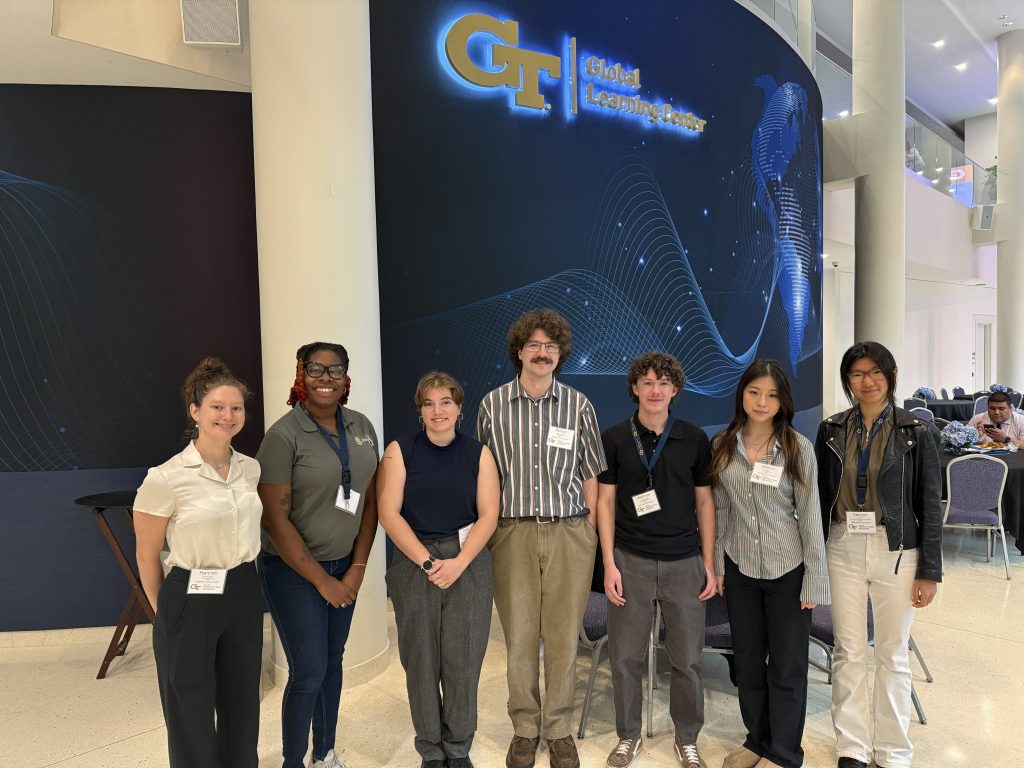
For many participants, the community they built was as meaningful as the research itself.
“One of my favorite parts of the REU was getting to know the other students and learning about the incredible range of research happening across JSNN,” said Hannah Hobbs, an NSF SENIC REU intern from Clemson University. “This summer strengthened my confidence in pursuing a career in research while also helping me better understand the kinds of scientific questions and research environments I’m most passionate about.”
For other students, hands-on lab experience helped reinforce their academic and career goals. “Getting to do hands-on work with things that I am interested in and plan to pursue later was my favorite part of the program,” said Ashli Gortman, a Semi-BELLS intern from University of North Carolina at Charlotte. “Being able to work in a lab outside of my own and participate in the classes helped me build a strong foundation for future research. My advice to future interns is that it’s okay not to know everything at first. Research is all about learning, so always be willing to ask questions and grow.”
Matthew Francoeur, an NSF SENIC REU intern from University of Connecticut, valued the opportunity to investigate sustainable materials and approaches to pollution remediation while gaining experience with nanomaterials characterization and instrumentation. “Having that practical experience will be invaluable as I continue pursuing my goal of earning a Ph.D. in nanomaterials,” Francoeur said.
Semi-BELLS intern Naim France-Fulton from Forsyth Tech Community College pointed to the independence the program offered. “My favorite part of the program was having the freedom to work on my own project while organizing my ideas, drawing conclusions and planning future goals,” France-Fulton said. “I gained valuable experience in 3D design, manufacturing, data analysis and presenting technical information. I would encourage future interns to identify what they want to accomplish early and take ownership of their research experience.”
Through these summer programs, JSNN is helping prepare the next generation of researchers, engineers and STEM professionals by equipping students with technical expertise, stronger scientific communication skills, professional connections and the confidence to pursue advanced study and careers in emerging technologies.
JSNN looks forward to welcoming a new cohort next summer through the SENIC SUIN REU and Semi-BELLS programs, and students interested in hands-on research in nanotechnology, semiconductors, advanced materials and related fields are encouraged to watch for upcoming application announcements and program information.
Programs and partners include the Joint School of Nanoscience and Nanoengineering, Georgia Institute of Technology, North Carolina State University, National Science Foundation and Department of War Microelectronics Commons.